For 5 remaining sessions $124.00 USD
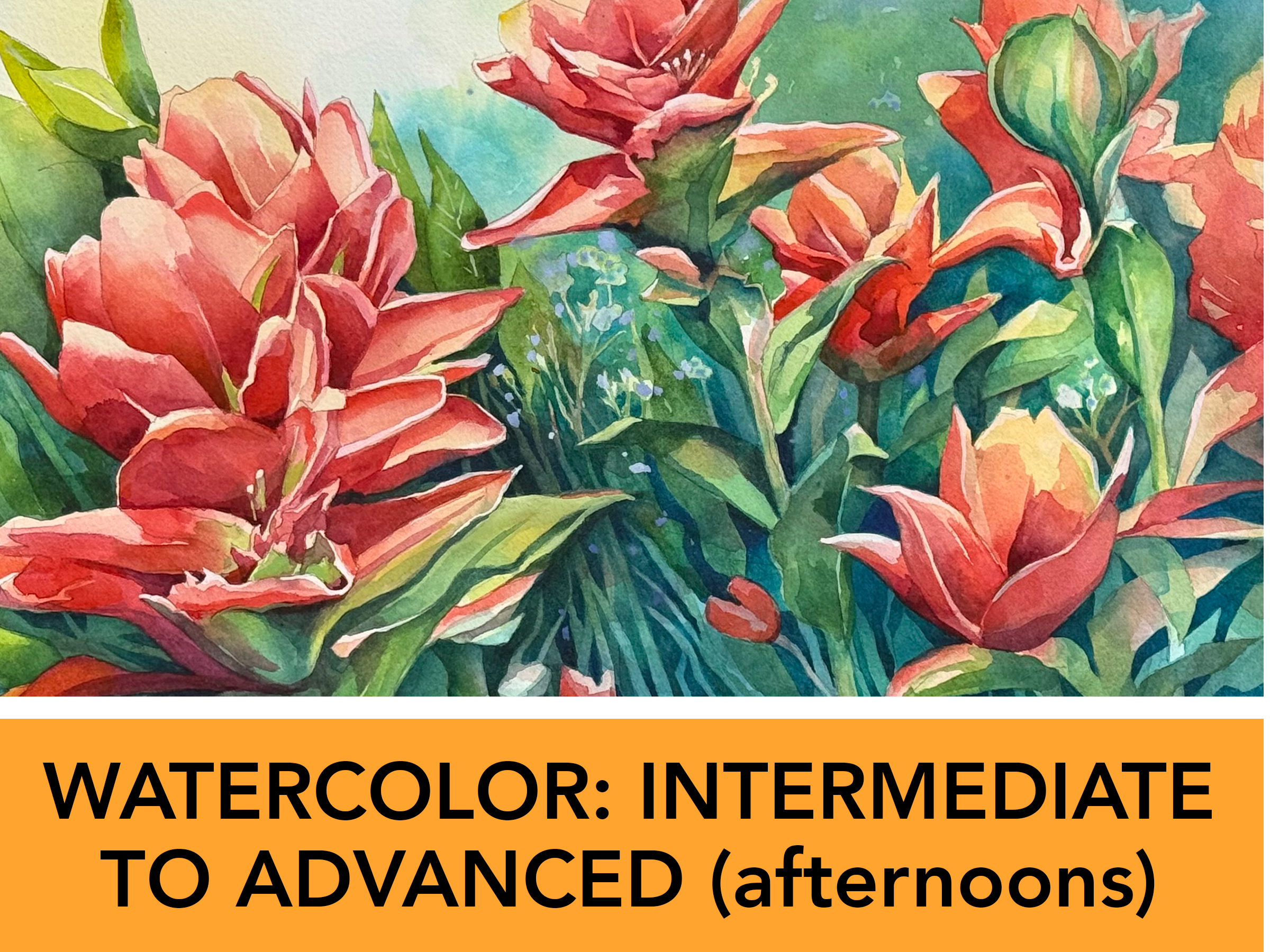
Try new techniques and paint new subjects in this 12-week watercolor class. We will review traditional watercolor techniques and explore alternative materials while challenging ourselves with a wide range of subject matters. Throughout the year, we will paint animals, figures, portraits, still-lifes, landscapes, seascapes, and urban scenes. This watercolor course is on-going, meaning we have new students register each term and other students opting to continue their watercolor study and practice. The instructor will have a prepared lesson plan each class. This option is good for students who want to continue to build skills or who may have some time constraints. Usually, each lesson is completed during one or two class periods. Alternatively, on-going students will have the opportunity to choose their own subject matter and focus on developing their own artistic voice. Students will be asked to provide their own references and will work with the instructor to determine the best approach. If you are a new student at VAI but have some painting experience, please let the process unfold. Alternatively, we recommend that artists who are new to watercolor take our Beginning Watercolor (also offered on Wednesdays) before jumping into our intermediate and advanced classes. MONTHLY TOPIC BREAKDOWN: Monthly topic will be determined at a later date SKILLS TAUGHT IN THIS CLASS: Skills taught include: Paint and water ratios, washes, glazing, layering, composition, planning, and a host of tips and tricks. SUPPLY LIST: Please read this list carefully. It is a very comprehensive list and is designed for you to use as a reference. You are not required to have all of these materials. If you are new to watercolor, begin with the “beginner’s list” and add materials as desired. PAPER: Arches #140 lb cold press watercolor paper is our preferred choice of paper. It is 100% cotton rag and can tolerate many glazes and scrubbing. You can purchase ONE full sheet (22 x 30”) and tear the sheet into quarters (11 x 15”). For this class you should have a least one full sheet or it’s equivalence. You can purchase a single sheet at Blick’s on 2100 south, SLC. They keep the paper in a draw so you may need to ask for assistance. As Arches paper is becoming more and more expensive, you have the option to supplement your stash with student grade watercolor paper in a pad. Recommended paper: Bee Paper Watercolor Artist Studio Pad 9 x 12 in. This paper is inexpensive and can be purchased online or at Walmart. SKETCHBOOK A watercolor or multi-media sketchbook is highly recommended, but not required. We will discuss the advantages of a sketchbook in class. You are encouraged to sketch as much as possible (5 minutes a day???), to help develop your artistic skills. PAINT (beginners – see beginners note below): I recommend purchasing tubes of watercolor paint. Utrecht, Blick’s, Winsor & Newton, Holbein, and Daniel Smith are recommended as they are professional paints. Winton and Van Gogh are acceptable but are considered student paints. Artist’s Loft paints are not acceptable. Some students have watercolors in “pans”. These are dried colors that are already pre-loaded in a palette. These are acceptable (if they are from a reliable brand) but you may need to supplement with some tube paints. Again, Artist loft “pans” are not acceptable. The following colors are suggested (you will probably buy more later). This basic list is considered a split primary palette, which means a warm and cool of each primary color. Hooker’s green, yellow ochre, and burnt sienna are add-ons. Lemon yellow Cad yellow light or medium Yellow ochre Cad red light Alizarin crimson Ultramarine blue Prussian blue Hooker’s green Burnt sienna This more extensive list is primarily made up of transparent watercolors. I was first introduced to palette by artist Ted Nuttall. His luminous portraits are created by adding thin, clean, transparent glazes. If you interested in this effect, you may want to keep this list handy. Note that certain brands are mentioned. H = Holbein, DS = Daniel Smith. Others are Winsor Newton. Tubes only): Perm Alizarin Crimson Vermillion (H) Scarlet Lake Brilliant Orange (H), Winsor Yellow Deep Aureolin Quin Gold Quin Burnt Orange (DS) Burnt Umber Hookers Green Mineral Violet (H) Inidigo French Ultramarine Antwerp Blue Winsor Blue Red Shade Peacock Blue (H) BRUSHES: One medium (#8) and one large (#12 or 14) round brush. Optional: one #4. I prefer Escoda Perla Torey white synthetic PALETTE: Something to mix your paints on. I recommend Mijello Fusion airtight watercolor palette (18 wells) or John Pike 10.5 x 15” watercolor palette. OTHER ITEMS: Pencils: #2B pencils are fine. #4H pencils are good for detail work. Erasers: A grey, kneaded eraser. Paper towels: VIVA blue paper towels are great, but any work well Tape: Masking tape to tape down paper. White or cream colors are preferred. Cotton rags: may be used instead of paper towels Board: Something to tape your paper on to. No need to purchase an expensive drawing board. Plexiglass, MDF board, Sintra boards (google it!), or gatorboards all work A carry tote or box: to stay organized! Easel: Something that will give you a slant. We can discuss this in class. Do not purchase a table easel before class. We have an inexpensive option available for purchase, if desired. Color wheel: Not required, but if you have one add it to your supply box Gouache paint: One tube of white, opaque gouache (not required) Mr. Clean Magic Eraser (original): to correct mistakes (not required) Personalized paint chart: In our Watercolors for Adults ongoing class, students should hand draw and paint their personal paint palette, once properly set up. Make sure to write the names of each color on your chart. We can discuss this in class, but you will need to do this exercise at home. It is advisable to laminate your completed chart. Personalized 7-square value chart: This is another exercise that should be completed at home. We can discuss this in class. SUPPLY LIST FOR BEGINNERS: PAPER: One Sheet Arches #140 lb of Hot Press WC Paper (at Blick’s in Sugarhouse) One pad of student watercolor paper. Preferred brand: Bee Paper Watercolor Artist Studio Pad 9 x 12 in. This paper is inexpensive and can be purchased online or at Walmart. PAINT: If you are new to painting and do not want to invest in a lot of paint, start with a kid’s set of Crayola or Prang Paints (DO NOT BUY OTHER BRANDS). These paints are inexpensive yet full of vibrant colors. If you decide to stay with watercolor, you’ll want to invest in more expensive paints. Tube paint if desired. See description above. BRUSHES: One medium (#8) and one large (#12 or 14) round brush. Optional: one #4. I prefer Escoda Perla Torey white synthetic. Order online from Blicks. PALETTE: Something to mix your paints on. I recommend Mijello Fusion airtight watercolor palette (18 wells) or John Pike 10.5 x 15” watercolor palette. OTHER ITEMS: Pencils: #2B pencils are fine. #4H pencils are good for detail work. Erasers: A grey, kneaded eraser. Paper towels: VIVA blue paper towels are great, but any work well Tape: Masking tape to tape down paper. White or cream colors are preferred. Cotton rags: may be used instead of paper towels Board: Something to tape your paper on to. No need to purchase an expensive drawing board. Plexiglass, MDF board, Sintra boards (google it!), or gatorboards all work A carry tote or box: to stay organized! Easel: Something that will give you a slant. We can discuss this in class. Do not purchase a table easel before class. We have an inexpensive option available for purchase, if desired. Color wheel: Not required, but if you have one add it to your supply box Gouache paint: One tube of white, opaque gouache (not required) Mr. Clean Magic Eraser (original): to correct mistakes (not required) Personalized paint chart: In our Watercolors for Adults ongoing class, students should hand draw and paint their personal paint palette, once properly set up. Make sure to write the names of each color on your chart. We can discuss this in class, but you will need to do this exercise at home. It is advisable to laminate your completed chart.
THERE WILL BE NO CLASSES THE WEEK OF THANKSGIVING!!!!
LOCATION:
Visual Art Institute 2900 S 300 W, South Salt Lake, Utah
Please park on the NORTH side of the building and enter up the ramp to the front office. It is the really colorful side of the building.
INSTRUCTOR:
This class is taught by Barbara Kidd. Learn more about our instructorsat https://www.visualartinstitute.org/art-faculty
DROP-INS:
This class IS open for drop-in students. Students can register online for a specific date or purchase a Flex Pass. Everyone is responsible for bringing their supplies for the class.
REFUND POLICY:
We are only able to offer refunds up to 2 weeks before the start of class. We do not offer refunds or credits or make-up classes to students who miss class.
TRANSFER POLICY:
We may be able to transfer you to a different class depending on space availability.
CLASS CANCELLATION:
We find that students learn better in larger groups. If we feel the number of registrations is too low to promote a good learning environment, we may cancel the class. In the event we cancel a class, we will reach out to you as soon as possible.
TUITION ASSISTANCE PROGRAM:
We try to make our classes as accessible to everyone as possible. We are able to offer a limited number of tuition assistance scholarships each term. You can complete an application on our website or call our office for assistance applying. Applications are available in Spanish and English.
MULTI-CLASS DISCOUNT:
When you register for more than one class, you can receive a discount up to 10% per class! You must call and register through the front office for this discount.
ADA ACCESSIBILITY & ACCOMMODATIONS:
Our classrooms are ADA accessible. Some courses may involve tasks or activities that may be difficult for individuals with limited strength, difficulty bending over, and sitting or standing for long periods of time. We are happy to work with students to find solutions to make their experience positive and doable. For example, wheel throwing takes arm strength and bending over the wheel. Students may work on hand-building projects instead of throwing. Please reach out to our office to discuss your needs.
DIFFICULTY REGISTERING?
Please call our main office for assistance! 801.474.3796 or email us at [email protected]
Participants must be 12 years to 110 years old when the program starts.
Registration starts on 04/15/2026 and ends on 12/02/2026.
Please contact Visual Art Institute if you have any questions.